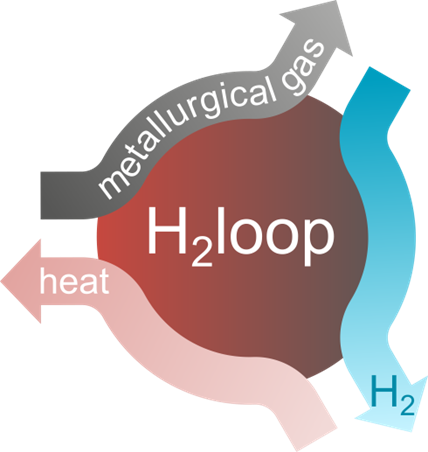
Hydrogen production from metallurgical gases will be a key enabler for sustainable steelmaking in the coming decade. However, current utilization of blast furnace and converter gases in power plants remains inefficient and emission intensive. The H2Loop project addresses this issue by implementing the Chemical Looping Hydrogen (CLH) process for on-site hydrogen production directly at steel plants.
H2Loop provides a flexible and modular solution that converts metallurgical gases into high-purity hydrogen, alongside a high-temperature nitrogen stream and a separate CO2-N2 stream. The technology builds on a successfully validated pilot plant for landfill gas, which will be adapted and scaled up to treat real blast furnace gas from the steelworks in Taranto, Italy.
A CLH demonstrator producing 1300 Nm³ H2/day will be constructed and operated at the Taranto site. Its operation will be fully monitored and controlled using a closed-loop control system based on a 3D transient CFD model and state-of-the-art edge AI. For the first time, a newly developed “metamaterial”, acting as an oxygen carrier within the reactor, will be deployed to enable the scale-up of the CLH process (patent pending). In parallel, additional metallurgical gases will be tested in the existing pilot plant to broaden applicability.
The consortium brings together a major steel producer (Acciaierie d Italia SpA), an innovative developer of process technologies (Rouge H2 Engineering AG), the University Politecnico di Torino with its Department of Energy (DENERG) and one of the leading steel research institutes (VDEh-Betriebsforschungsinstitut GmbH) in the European Union to enable efficient technology transfer, promote industrial innovation and ensure long-term implementation for the scale-up of CLH technology.